
Blog
OEM vs White Label vs Private Label E-Liquids: What's the Difference?
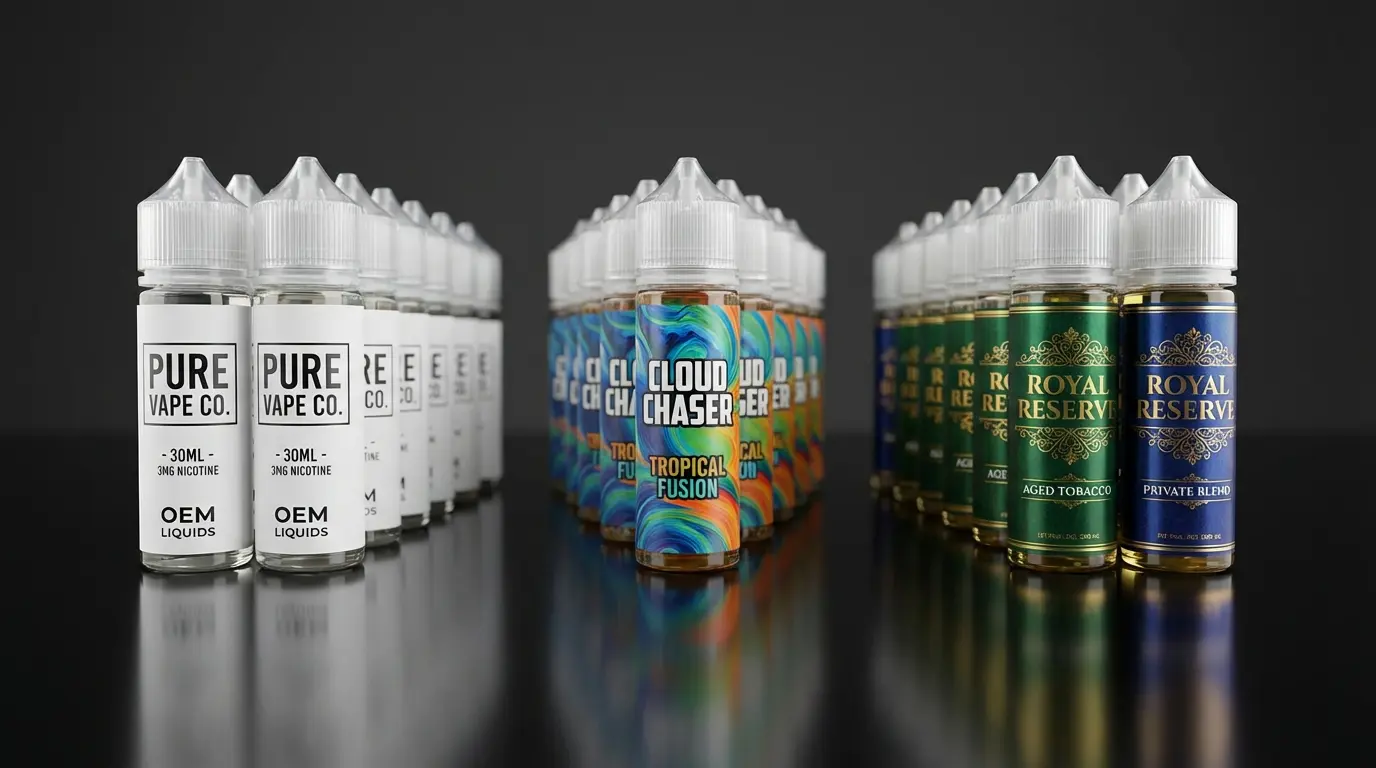
Three Ways to Launch an E-Liquid Brand
If you are looking to enter the e-liquid market, you do not necessarily need to build a manufacturing facility from scratch. There are three established business models for bringing e-liquid products to market, each with different levels of investment, customization, and time-to-market. Understanding the differences is the first step in choosing the right path for your business.
White Label
White label is the simplest and fastest route to market. Here is how it works:
- The manufacturer has pre-existing, ready-made products already formulated, tested, and (in many cases) TPD-registered
- The buyer adds their own branding only — logo, label design, company name
- The liquid formulation itself is identical to what the manufacturer sells under other brands
- No recipe customization is available
When to choose white label:
- You want to enter the market as quickly as possible with minimal upfront investment
- You are a retailer, distributor, or vape shop looking to offer a house brand
- Speed and cost matter more than product differentiation
Trade-offs:
- Least differentiation — your competitors may sell the exact same liquid under their own labels
- No control over the formulation or flavor profile
- Limited ability to build a unique brand identity around the product itself
Private Label
Private label sits in the middle — more customization than white label, but without the full control of OEM:
- The manufacturer offers pre-developed formulas as a starting point
- The buyer can request limited customization on design, ingredients, packaging, or nicotine strengths
- The manufacturer handles production, testing, and often regulatory registration
- The final product is exclusive to the buyer’s brand
When to choose private label:
- You want some product differentiation without the cost and timeline of full custom development
- You have specific packaging or branding requirements
- You want to tweak existing formulations rather than developing from scratch
Trade-offs:
- Customization is limited to what the manufacturer offers — you cannot bring a completely unique recipe
- Lead times are longer than white label (weeks vs. days)
OEM (Original Equipment Manufacturer)
OEM is the most customized model. The buyer has maximum control:
- The buyer provides the formula or specifications, and the manufacturer produces to those exact requirements
- Alternatively, the manufacturer’s R&D team develops a completely custom formulation to the buyer’s brief
- Full control over ingredients, PG/VG ratios, nicotine strengths, flavor profiles, and packaging
- The buyer owns the recipe (or licenses it, depending on the agreement)
When to choose OEM:
- You have a unique product vision and want full control over what goes into the bottle
- You are building a premium brand where flavor differentiation is a core value proposition
- You have the budget and timeline for custom R&D and testing
Trade-offs:
- Highest cost — custom R&D, formulation, emissions testing, and TPD registration all add up
- Longest lead time — recipe development, testing iterations, and the 6-month TPD notification period
- Requires more involvement from the buyer in the development process
Comparison Table
| Factor | White Label | Private Label | OEM |
|---|---|---|---|
| Customization | Branding only | Limited (design, some ingredients) | Full (formula, packaging, everything) |
| Cost | Lowest | Medium | Highest |
| Time to market | Fastest (days to weeks) | Medium (weeks to months) | Longest (months) |
| Product uniqueness | Low | Medium | High |
| MOQ | Usually lowest | Medium | Often highest |
| R&D involvement | None | Minimal | Significant |
Shortfills and Longfills: TPD-Friendly Formats
Two product formats have become popular specifically because of how they interact with TPD regulations:
Shortfills
A shortfill is a nicotine-free e-liquid in a bottle larger than its contents, leaving room for a nicotine shot:
- Typical format: 50 mL of liquid in a 60 mL bottle
- The consumer adds a separate 10 mL nicotine shot (e.g., at 18 mg/mL)
- Result: 60 mL of e-liquid at approximately 3 mg/mL nicotine
- Because the liquid itself ships nicotine-free, the liquid portion does not fall under TPD Article 20 volume limits (the 10 mL cap applies only to nicotine-containing refill containers)
Longfills
A longfill is a nicotine-free flavor concentrate in an even larger bottle:
- Typical format: concentrate in a 60-120 mL bottle, designed to be filled up with VG/PG base and nicotine shots
- More room for multiple nicotine shots means the consumer can reach nicotine strengths of 3-12 mg/mL
- Like shortfills, the product ships nicotine-free, so the liquid portion does not require TPD notification
The TPD Registration Shortcut
For brands using shortfill or longfill formats, the liquid portion ships nicotine-free and therefore does not require the standard TPD Article 20 notification process. However, the accompanying nicotine shots do still need to be registered.
There is also a legitimate strategy for brands selling TPD-regulated 10 mL nicotine-containing products: registering a brand as a sub-brand under an existing registered product line can bypass the standard 6-month waiting period, since the base formulation has already been notified and approved.
Choosing the Right Model
The right model depends on your business goals:
- Testing the market? Start with white label to validate demand with minimal risk
- Building a brand? Private label gives you differentiation without full R&D costs
- Creating a premium product line? OEM gives you complete control over the product
Many businesses start with white label or private label and transition to OEM as their brand grows and they can justify the investment in custom formulation. For a complete guide on the full process, see our article on How to Start Your Own E-Liquid Brand in Europe.
References
- Liquidable — White Label vs Private Label E-Liquids
- Xyfil — OEM E-Liquid Manufacturing
- Chemnovatic — Private Label and OEM Solutions
- JM Distro — Shortfill and Longfill Explained
- T-Juice — E-Liquid Manufacturing Services
- Vape Superstore — Guide to Shortfills and Longfills
First 5 Labs: All Three Models
First 5 Labs offers all three models — OEM, white label, and private label — with full-service support from recipe development to TPD registration. Whether you are launching your first product or expanding an existing line, we handle the entire process. Explore our OEM solutions.